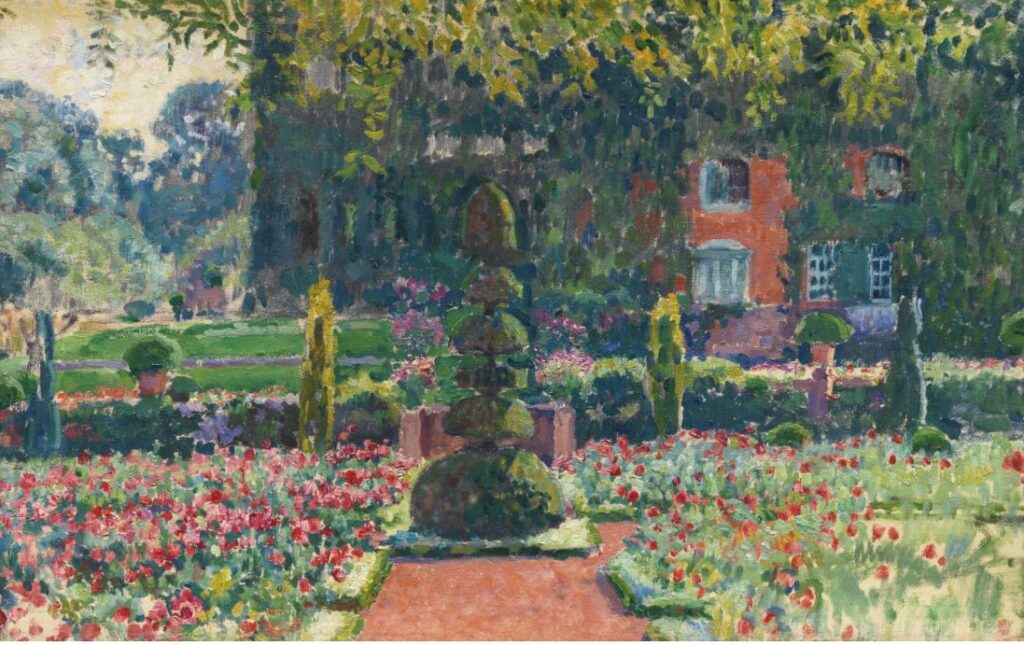
Presented and sold by Sotheby’s as a work by Théo Van Rysselberghe, this attractive painting—which I examined in New York in 2014—is undoubtedly decorative with its shimmering colours and bears a stamp described as a ‘studio stamp’. This term refers to the stamp affixed by the heirs of a deceased artist to unsigned works still in the studio at the time of death. This is the case with many paintings by Monet and Renoir, for example, which were marked with a studio stamp by the respective sons of these two great painters. Van Rysselberghe’s widow and his only daughter never affixed any stamp whatsoever to the works found in his studios in Saint Clair and Paris at the time of the artist’s death. This monogram-shaped stamped mark, framed like the ‘Atelier Van Rysselberghe’ stamp, was devised by unscrupulous dealers such as Guy Pogu (who sold many genuine Van Rysselberghe works) in the 1960s and can be found on both genuine and non-genuine works.
The presence of either of these two stamps should always raise a red flag. But how can one blame the blind man, who cannot see a thing (to the extent that he included an authentic work by George Morren in a Van Rysselberghe catalogue…), for having imagined, on the basis of this single stamp alone, that this lovely painting might have been a work by Théo Van Rysselberghe? It is not a forgery in the strict sense; it is an authentic painting by another artist. A forgery would, at the very least, bear some resemblance to the style of Théo Van Rysselberghe. That is my opinion; everyone is free to form their own. The problem is that, on the basis of this ersatz catalogue raisonné, Sotheby’s decided to present this painting as being by the famous painter. It was sold for $90,000 excluding fees in 2005 and $80,000 excluding fees in 2014. A very bad deal, certainly, but a substantial sum was recovered nonetheless. Let us hope that such carelessness would not be repeated today.